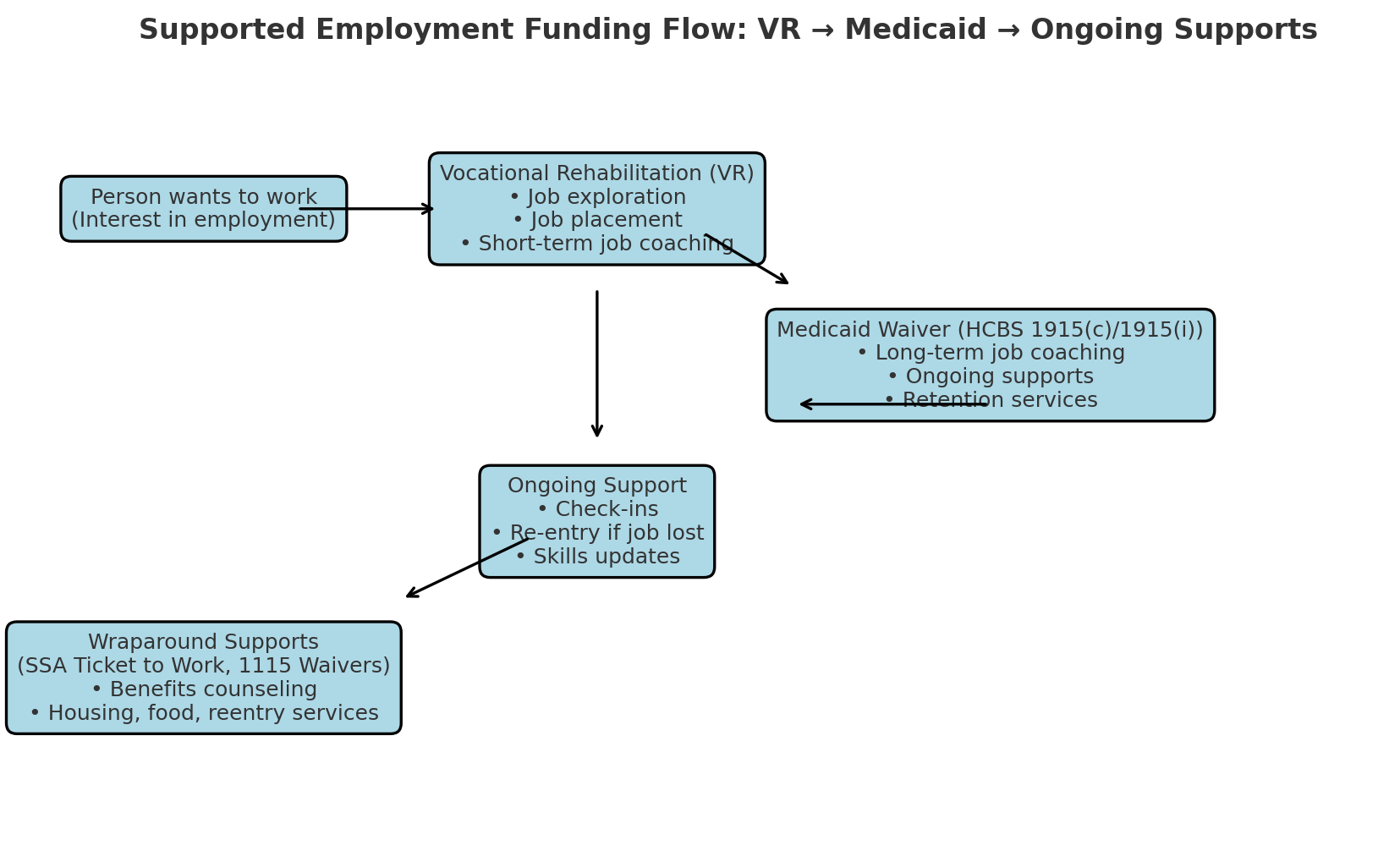
We will illustrate how Supported Employment services are typically funded and delivered in the
United States. The flow shows the transition from short-term job supports funded by Vocational Rehabilitation
(VR) to long-term supports funded by Medicaid waivers, with optional wraparound supports from Social
Security and state programs
1
Step 1 – Interest in Employment
An individual expresses the desire to work. A case manager or intake coordinator assesses eligibility for Vocational Rehabilitation (VR) and Medicaid waiver services.
2
Step 2 – Vocational Rehabilitation (VR) Services
VR provides short-term supports, including job exploration, application assistance, job placement, and initial job coaching. Funding is time-limited, typically 3–6 months.
3
Step 3 – Transition to Medicaid Waiver
Once the person is employed, long-term supports are needed. Medicaid Home and Community-Based Services (HCBS) waivers, such as 1915(c) or 1915(i), cover ongoing job coaching and retention services.
4
Step 4 – Ongoing Support
The individual continues receiving check-ins, skills training, or re-entry supports if employment is lost. Supports can increase or decrease depending on need.
5
Step 5 – Wraparound Supports
Other programs may provide additional support: SSA’s Ticket to Work helps individuals maintain benefits while working, and Medicaid 1115 waivers may connect employment to housing, food, and reentry services.
Last modified: Thursday, 11 September 2025, 7:58 PM